




What Causes Dry Mouth?

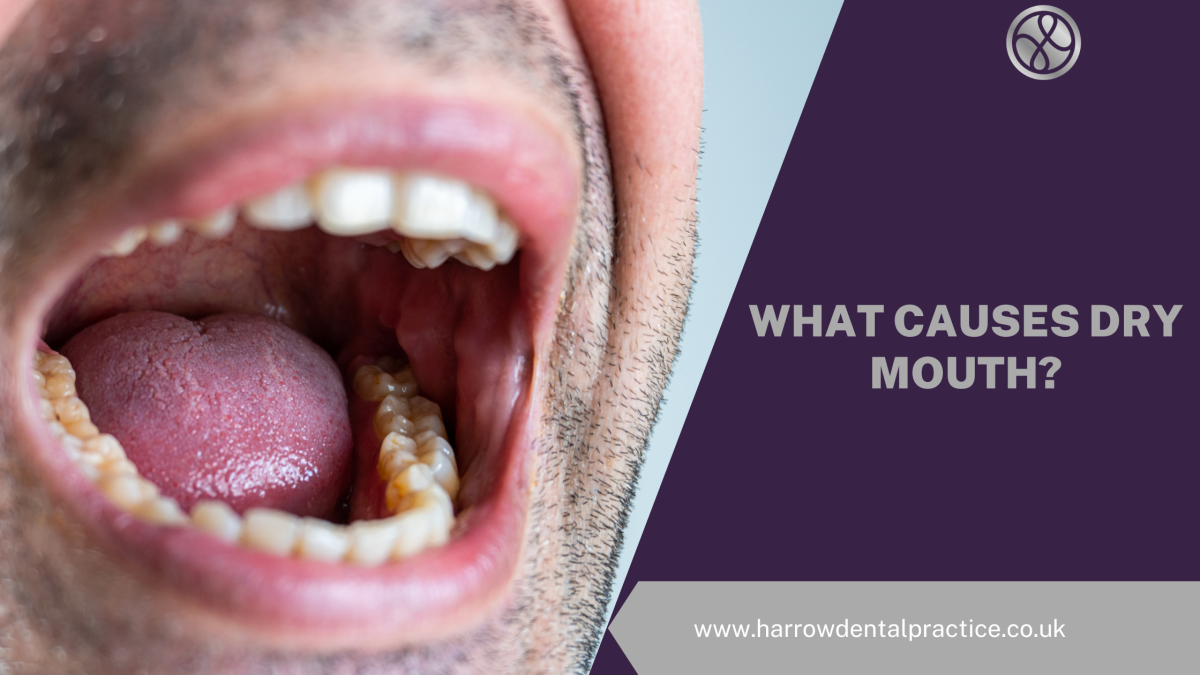
Do you have a constant feeling of dryness in your mouth? Are you troubled eating or speaking because of insufficient saliva in your mouth? If yes, you may be suffering from a condition called dry mouth. Unfortunately, dry mouth is quite a prevalent condition in the UK. According to the NHS, one in every four British adults suffers from dry mouth. If you want to know more about what causes dry mouth and its treatment, this blog is for you. 

Continue reading until the end to learn everything you need to know about this condition. 

What Is “Dry Mouth”?

According to the American Dental Association, dry mouth, also known as Xerostomia, is a condition characterised by the feeling of dryness in the mouth. Dry mouth can occur for various reasons, and it isn’t always an indication of an underlying serious condition. 

Why Am I Experiencing Dry Mouth All Of A Sudden?

A sudden feeling of dryness in the mouth could be due to various reasons, such as dehydration, mouth breathing while sleeping, and certain medications. Besides, it could also be due to various underlying conditions such as diabetes and salivary gland disorders. 

What Is The Difference Between Dry Mouth And Xerostomia?

Both dry mouth and xerostomia refer to the same thing. Xerostomia is the scientific term dentists and doctors use to describe the feeling of dryness in the mouth. So, dry mouth is a “layman” term, while xerostomia is the scientific name for this condition. 

How Does Ageing Contribute To Xerostomia (Dry Mouth)?

The likelihood of xerostomia increases with age. Research statistics show that over 30% of adults over 65 and 40% over 80 years suffer from this condition. However, according to the US National Institutes of Health, the risk of xerostomia doesn’t increase directly because of ageing. Instead, it is linked to an increased risk of systemic conditions that affect salivary production or flow with age. Moreover, the elderly are more likely to take various medications that can cause dry mouth as a side effect. 

What Can I Do About Dry Mouth Caused By Medication?

As mentioned earlier, dry mouth can also be caused due to various medications. If you’re feeling dry mouth after taking a new medication, it is most likely a side effect of the medicine. In such cases, your dentist will discuss with your general practitioner so that they can advise you on an alternative medication. In most cases, dry mouth condition goes away as soon as the causative medication is discontinued. However, if left untreated, it can cause various complications including tooth pain and detnal cavities.

What Are The Best Foods And Remedies For Dry Mouth?

There are a few things people with dry mouth can do to ease the condition. 

  • Hydration – This is one of the effective ways to offset dry mouth. Sipping water throughout the day helps keep the mouth moist. 
  • Sugar-free Chewing Gum – Did you know that eating a chewing gum helps stimulate the salivary glands? As a result, the flow and production of the saliva are enhanced. However, one should chew a sugar-free gum because sugar-containing gums can increase the risk of tooth decay. 
  • Soft Diet – Soft, moist foods such as stews, scrambled eggs, and soups are easier to eat with a dry mouth. 
  • Artificial Saliva – Saliva substitutes are easily available in the market and can be used to keep the mouth moist. 

These measures will only provide symptomatic relief. For comprehensive treatment, the underlying issue should be diagnosed or treated by a healthcare practitioner. 

What Is The Link Between Dry Mouth And Bad Breath?

One of the major roles of saliva, besides keeping our mouths moist and aiding in chewing/digestion, is that it keeps the mouth clean. Saliva constantly flows in the mouth and provides a bathing and cleansing action, thereby helping maintain good oral hygiene. In patients with xerostomia, this bathing action is affected, and plaque or tartar deposits begin to form on the teeth. Over time, degradation of the adhered food particles results in a bad odour, resulting in bad breath and gum disease. This is why people suffering from dry mouth often complain of oral malodor. 

How To Treat Dry Mouth?

The treatment of dry mouth mainly depends on identifying and treating the underlying issue. Dry mouth can occur due to two reasons: due to reduced salivary flow (blockade) or its production. Your dentist will perform a detailed clinical examination to ascertain the underlying cause. 

If your dentist feels that your dry mouth is due to a non-dental reason, they will refer you to your family doctor. Some of the non-dental reasons for dry mouth include:

  • Certain medications 
  • Systemic illnesses such as diabetes or Sjögren’s syndrome
  • Salivary blockade due to stones in the salivary duct
  • Physical damage to the salivary glands due to trauma or radiation 
  • Salivary gland tumours 

If the dry mouth is due to a medication, your doctor will replace it with another one. On the other hand, if the problem is due to salivary duct blockade, they will consider various surgical or non-surgical options to remove the stone and relieve the pain. Finally, if it is due to a tumour, your dentist will consult with a maxillofacial surgeon to remove it. 

If you or a loved one is experiencing dry mouth, they shouldn’t take this condition lightly and visit a dentist immediately. If you live in Essex, you should visit Harrow Dental Practice and Dental Implant Centre for all your dental concerns. We provide high-quality dental services at affordable prices and under one roof. Click here to make an enquiry. We look forward to serving you. 
Finding A Good Childrens Dentist Near Me

As parents, we want the best for our kids; the best education, comfort, excellent quality of life and, more importantly, the best health. While we take care of virtually every aspect of our child’s upbringing and care, many parents ignore a crucial aspect: their children’s oral health. 

“But why is the oral health of my child so important? After all, their milk teeth will be replaced with permanent ones”, you may ask. The answer is that your child’s milk teeth are equally important as their successors because your kid will learn good dental hygiene and dietary habits with their primary teeth. Furthermore, milk teeth serve as placeholders for permanent ones. If the milk teeth get damaged or lost prematurely, it can cause complications later in life, such as tooth misalignment and speech and jaw joint disorders. 

That is why it is crucial that parents must take their kids for dental health checks regularly. But how to find a good kids’ dentist near me? You may ask. But don’t worry; this blog is there to help. This blog mentions practical tips that will help you find the right paediatric dentist in town. So, read on!

How To Find A Good Dentist Near You And Your Kids?

If you have recently moved into a new neighbourhood or your child has just grown their first milk tooth, you might be looking for the best children’s dentist in your area.

  1. The first thing to do is to ask your colleagues, friends, and relatives for recommendations regarding kid dental practices near your office, home, or kid’s school.
  2. Furthermore, you should also search online for paediatric dental practices in your area and shortlist a few with the highest online ratings.
  3. Next, your should visit each practice and meet the dentist and their team.
  4. Finally, you should select a practice that your child feels comfortable with.   

What Do You Look For In A Pediatric Dentist? 

While selecting a good paediatric dental practice for your child, you should consider the following factors:

  • Select a practice that offers all paediatric dentistry-related services under one roof
  • The paediatric dentist should have sufficient experience treating dental disorders in children
  • The practice should have a gentle-dental team with a purpose-built operatory that soothes the patients and allays their fears.
  • Accepts your family dental insurance. Alternatively, it should offer flexible payment plans. 

What Dental Clinic Is Best For Children?

A dental clinic that offers an entire range of paediatric dental services under one roof and has an experienced and qualified paediatric dentist available is the best practice for your kid’s dental treatment. 

What Are Dentist Tips For A Child’s First Go-To Dentist?

As mentioned earlier, you should select a paediatric dental practice close to your child’s school, home, or workplace. Furthermore, you should go with a practice with an experienced and qualified dentist with a proven track record of treating paediatric dental issues. You should also ensure that the practice you select accepts your family’s dental insurance or offers flexible payment plans. Most importantly, go with a practice that has a friendly, welcoming, and gentle-dental team

How Frequently Do Your Kids Visit Pediatric Dental Clinics?

The frequency of your child’s visit to a paediatric dentist mainly depends on their oral health status. For example. Kids with healthy, cavity-free teeth may need to see their dentist twice a year. On the other hand, if a kid has underlying dental issues like teeth cavities or gum disease, they may need to visit more frequently. So, your child’s dentist will suggest the frequency of your child’s checkup visits after a thorough clinical examination. 

How To Prepare Your Child For Their First Visit To The Dentist?

Many children fear visiting the dentist because they think their treatment will be uncomfortable or painful. Therefore, parents must counsel their kids that they are only visiting for a checkup and there will be no invasive or painful procedure. Once the child is convinced, they will be less hesitant and more cooperative during their appointment. 

What Do People Look For In Choosing A Dentist?

When choosing a dentist, people should look for the following:

  • A highly experienced and skilled dentist available at the practice 
  • Vicinity to their home, office, or kid’s school
  • An entire range of dental services provided under one roof for the family 
  • Family dental insurance accepted
  • If insurance is not available, the practice should offer flexible payment plans
  • Round-the-clock dental emergency services are available 

How Do You Choose A Dentist For Your Toddler?

Dental care for your kids should start right from their toddler years. If you are looking for a good dentist for your toddler, you should remember the tips for choosing a paediatric dentist near you mentioned in this blog. 

What Types Of Treatments Do Pediatric Dentists Provide?

Paediatric dentists are dental professionals who have undergone additional 3-4 years of clinical training to specialise in treating dental issues related to kids. Some of the services provided by paediatric dentists are:

  • Prevention and diagnosis of tooth decay 
  • Counselling the kid and their parents regarding a tooth-friendly, healthy diet 
  • Diagnosing and treating common dental issues such as gum disease 
  • Monitoring the growth pattern of the child’s teeth and taking reparative measures in case of an anomaly

If you are looking for a good kids’ dentist in Hornchurch, Essex, Harrow Dental should be your first choice. We provide all paediatric dental services under one roof at affordable rates. So, book an appointment today and let us take good care of your child’s pearly whites and their smiles. 

Banish The Worry – Helping You Stay Calm At The Dentist

Have you been postponing your dental checkup visits? Does the mere thought of visiting a dentist sends chills down your spine? Would you rather bear excruciating toothache than seek dental treatment? If the answer to these questions is a yes, then you are suffering from dental anxiety. But you’re not alone! Statistics show that over 53% of Britishers have some form of dental phobia. 

But, here is the good news; regardless of your type and degree of dental anxiety, it is manageable! This blog offers practical solutions to help you get rid of your dental fears and enjoy a healthy, lasting, and beautiful smile. So, continue reading to find out!

What Is Dental Anxiety?

Dental anxiety refers to the fealing of uneasiness or anxiousness whenever one has to undergo dental treatment. For some people, the anxiety is so severe that they cannot even step their feet into the dentist’s office. 

Why Are Many People Afraid Of Going To A Dentist?

Dental anxiety and phobia can be of different types. For some people, fear of dental treatment stems from a previous painful or bad experience. Some are afraid that dental treatment will be painful or the anaesthesia won’t work, while others are afraid of the sound of dental needles or the sound of the dental drill. So, dentists have to manage each patient’s apprehensions and anxiety according to the underlying cause. 

How Do Dentists Cope With Patients That Are Anxious Or Phobic?

Dentists have several tools under their belts to manage apprehensive or anxious patients. The first thing dentists do is have a frank conversation with their patients to identify the underlying cause. Once they know the root cause, they will take measures to eliminate it. 

For example, if a patient feels that they don’t have any control during their treatment, dentists will use a technique called “tell, show, do”. In this technique, they will avoid any sudden movements and before performing any procedure, they will explain it to the patient and show how its done. In this way, there are no surprises for the patients that may make them anxious. 

In other cases, dentists divert the attention of their patients by asking them to listen to their favourite music, or watch a movie while treatment is being done. Again, this helps the patient relax and foget about their treatment. 

Another option available to dentists is sedation dentistry, which involves the administration of a medicament – through inhalation, orally, or intravenously – to make them drowsy but conscious enough to respond to the dentist’s instructions. 

How Do You Talk To Your Dentist About Dental Anxiety?

As a patient, you should understand that your dentist is there to allay your fears and make you comfortable and relaxed during treatment. Therefore, you should discuss all your worries and apprehensions frankly with them. In this way, your dentist will be able to find a solution and help you relax while they are looking after your dental health. 

Do Doctors And Dentists Hate To See Anxious Patients?

Dentists love their patients! They want to help you enjoy perfect oral health and a beautiful, attractive, charming smile. So, there is no way dentists hate anxious patients. In fact, they are even more helpful and courteous to apprehensive patients as they want to ensure they enjoy the same perfect oral health as patients without dental anxieties. 

How Can You Not Be Scared To Go To The Dentist?

The best way to overcome dental fears is to talk to your dentist. Depending on the causes of your dental anxiety, they may suggest corrective strategies such as sedation dentistry or cognitive behavioural therapy. But, first, you must trust that your dentist has your best interest at heart, and they will do everything to ensure that you remain pain-free and relaxed when you visit them. 

How Do You Combat Nerves Before Visiting The Dentist?

If you feel anxious about going to the dentist, you may ask them to prescribe you an oral medication to calm your nerves. You should take medicine the night before your visit and then half an hour before your appointment. This way, you will feel much more relaxed at the dentist’s office. 

What Are My Options If I’m Terrified Of The Dentist?

Several options are available to eliminate your fear of dental treatment. For example, you could ask your dentist to perform the treatment under sedation. Alternatively, you may distract yourself by listening to music or enjoying a movie during your treatment. 

How Can I Overcome My Fear Of Going To The Dentist?

The first step in overcoming your dental fears is realising that the dentist is your friend, and they are there to help. You should discuss your concerns with them openly, so they can suggest a suitable option to say goodbye to your dental worries. Another thing is realising that dentistry has come a long way! Today, there are potent anaesthetics available that will ensure complete pain relief. Besides, sedation dentistry has made things really easy for individuals who fear dental treatment. 

How To Deal With Anxiety Regarding Daily Oral And Dental Care?

Some people have anxiety while performing routine oral hygiene procedures like brushing and flossing. If you are one of them, no need to worry; there are ways to eliminate your anxiety. First, you should brush your teeth when you feel most relaxed during the day. Alternatively, you may brush your teeth with a loved one or family member. This will help you distract  yourself from your worries. 

How To Get Over My Fear Of Being Judged If I Go To The Dentist?

Dentists are trained NOT to judge any patient based on their oral hygiene status or dental anxiety levels. So, you don’t have to worry; your dentist will not judge you. In fact, they will commend you that you mustered the courage to overcome your fears and sought dental help. 

If you are looking for a gentle-dental office in Hornchurch, then Harrow Dental Practice and Dental Implant Centre should be your first choice. Why? Because we offer high-quality, gentle-dental services to our patients in a relaxed and comforting environment. Besides, our dentists are trained to treat anxious and apprehensive patients. So, what are you waiting for? Book an appointment today and say goodbye to your dental fears!

Root Canal Treatments – Your Comprehensive Guide

For many people, the word “root canal treatment” is synonymous with pain and discomfort. But, this is actually not true. Every day, dentists perform thousands of root canal procedures globally and save millions of teeth from extraction each year. If your dentist has recommended a root canal procedure for one of your teeth, you might be wondering what this procedure actually is, whether it is safe, when it is needed. Continue reading to find everything you need to know about root canal treatment

What Is A Root Canal? 

 A root canal refers to space within the tooth roots that are filled with the dental pulp – the nervous tissue of the teeth which contains the nerves and blood vessels that nourish and innervates a tooth. Under healthy conditions, the sensitive dental pulp remains protected from the outside by outlying dentine and pulp layers, respectively. The problem begins when tooth decay, wear, or trauma destroys the outer tooth layers and exposes the underlying pulp. If this condition is not corrected timely, the pulp tissue may get irreversibly inflamed, leading to a painful condition. 

When this happens, the only option available to your dentist to save this tooth from extraction is to perform a root canal procedure. According to the American Association of Endodontists, a root canal procedure involves removing the inflamed pulp tissue followed by thorough cleansing of the root canals and then filling it with an inert material to prevent future infections.  

How Is A Root Canal Done On A Front Tooth? 

Whether it is the front or a back tooth, the steps involved in performing root canal treatment remain essentially the same. However, a fundamental difference between the front and back teeth is that the front teeth have only one root that is considerably longer. In the case of a front tooth, your dentist will first drill a hole in the tooth to expose the pulp chamber. Afterwards, they will use specialised endodontic equipment to remove the inflamed pulp tissue, followed by thoroughly washing the tooth’s interior with an antiseptic solution and then drying it. 

Dentists endodontic files to shape the tooth’s interior in a tapering fashion and then fill it with an inert material. They will then place a temporary filling on the tooth while the healing takes place inside the tooth. After a few weeks when the tooth’s interior has healed, your dentist will replace the temporary filling with a permanent one. 

Does A Root Canal Kill A Tooth? 

A root canal procedure involves removing the inflamed pulp tissue from the tooth’s interior. Since the dental pulp is responsible for innervating and nourishing the tooth. So, the tooth loses its nourishment and nerve supply following root canal treatment. This is also why teeth become brittle and weak after endodontic treatment. 

What Are The Steps Involved In A Root Canal Treatment? 

A root canal is an endodontic (endo=inside, odont=teeth) procedure that is completed in multiple steps. During your initial appointment, your dentist will perform a clinical examination of the affected tooth. They will also look at the x-ray images of the tooth to see the extent of the damage. Your dentist will drill a hole in the tooth to expose the underlying infected pulp, to relieve the pressure and pain. 

During the next appointment, your dentist will use specialised endodontic equipment to remove the infected pulp from the tooth’s interior. Afterwards, they will use antiseptic solutions or saline water to wash and clean the root canal. After the root canal has been dried, they will insert an inert rubbery material called gutta-percha to fill the tooth’s interior. This is done to prevent future chances of infection. After this, your dentist will place a temporary filling over the tooth until healing ensues. Once the tooth has healed, your dentist will replace the temporary filling with a permanent one. If required, they will also attach a crown over the restored tooth to reinforce it. 

Should I Have A Root Canal Or Extraction? 

A root canal is your dentist’s attempt to save a damaged tooth from extraction. Since no tooth-replacement option is better than your natural teeth, a root canal procedure should always be preferred over tooth extraction.  

How Long Does Root Canal Take? 

Dentists typically perform a root canal procedure in multiple sittings. The time required to complete the procedure depends on various factors,  such as the location of the tooth and the extent of infection. Generally, it requires two to three sittings for completion. However, in some cases, dentists choose to perform a root canal procedure in a single sitting. 

How Safe Is A Root Canal?

Like all other dental procedures, a root canal treatment procedure is absolutely safe, provided it is performed by a qualified and experienced dentist or endodontist. So, you can rest assured that a root canal procedure will have no effect on your oral health or physical wellbeing. 

What Is The Cause Of Biting Pain After Root Canal?

Biting pain following a root canal can occur due to two reasons. Firstly, a “high” filling which puts pressure on the tooth whenever the opposing teeth mate. Another reason for post-root canal biting pain may be accidental damage to the tooth’s tissues, called the periodontal ligament. This type of pain typically goes away as soon as the damaged tissue heals up. 

Whether you need a root canal treatment, dental fillings, or Invisalign aligners, Harrow Dental Service is at your service. So book a consultation appointment today and let us experienced and qualified dentists to take care of all your dental problems in a calm, relaxing and pain-free environment.